
Air - Sea - Land and Rail Junction Point of Global Trade
Investments spanning air cargo, land and railway corridors, modern port infrastructure and border gates have turned Türkiye into a strategic logistics hub connecting Europe, Asia and the Middle East.
THANKS to its unique geographical location, Türkiye has assumed a bridge role in global trade and has become a critical logistics center for air, land, rail and sea transportation. Major infrastructure investments and expanding global cooperation in recent years have further strengthened the country’s position in international trade. With an extensive transportation network ranging from air cargo and land corridors to railway lines and ports, Türkiye stands out as a strategic transit point between Europe, Asia and the Middle East.
EUROPE’S BUSIEST AIR CARGO HUB
Türkiye’s aviation sector has recently achieved global-scale success. Istanbul Airport-the country’s largest airport-became Europe’s busiest air cargo hub just a few years after its opening. In 2024, nearly 1.97 million tonnes of cargo were handled at Istanbul Airport, representing a 40 percent increase compared to the previous year. With this performance, Istanbul surpassed Frankfurt, which had long held the leading position, and earned the title of ‘Europe’s busiest cargo airport’.
SIXTH IN THE GLOBAL RANKING
Having grown rapidly over the past two decades, Turkish Cargo now accounts for nearly five percent of the global air cargo market, ranking sixth worldwide among cargo carriers. This means that one out of every twenty air cargo shipments worldwide is handled by Turkish Cargo. The company operates direct cargo flights to more than 100 destinations with its fleet of 24 dedicated freighters, while serving over 350 destinations through the cargo capacity of its wide-body passenger aircraft. This extensive network has transformed Istanbul into an intercontinental transit center and a critical transfer hub linking the Far East, Europe, the Middle East and Africa.
WORLD’S THIRD LARGEST CARGO CENTER
Türkiye’s infrastructure investments in air cargo have significantly enhanced its competitiveness on a global scale. The mega-sized cargo facility SMARTIST, operating at Istanbul Airport, has been designed as Europe’s largest and the world’s third-largest air cargo center. Fully equipped with advanced automation systems, the facility supports Turkish Cargo’s growth targets with an annual processing capacity of 4 million tonnes. The Ministry of Transport and Infrastructure aims to position Istanbul Airport among the world’s most prominent air cargo hubs.
BORDER GATES RENEWED
Türkiye effectively leverages its geographical advantage in land transportation and remains an indispensable transit country between Europe and Asia. With road connections to 70 countries, Türkiye’s bridge role between Europe and Central Asia makes land routes particularly critical for global trade. Although around 85 percent of global trade is carried by sea, a relatively high 41 percent of Türkiye’s exports-approximately US$ 107bn-are transported by road. This high volume has turned Türkiye into a lifeline for regional trade. Trucks departing from Türkiye are heavily engaged in export transportation to the Middle East, the Caucasus and Central Asia. In 2024, 57 percent of export road transport services were directed to Middle Eastern and Central Asian countries. Iraq ranked first with 492,000 trips, followed by Syria (189,000) and Germany (146,000). Road transport to Europe also remained strong. In 2024, export shipments to Europe reached 897,000 trips, and US$ 65bn of the US$ 131bn worth of goods exported to Europe were transported by road. These figures demonstrate the high performance and capacity of the Turkish trucking fleet in both eastern and western directions, contributing significantly to regional trade vitality. President of the International Transporters Association (UND), Şerafettin Aras, stated: “Türkiye is one of the most prominent transit countries in the new global trade order. The transport route extending from Europe to China and Central Asia continues to strengthen Türkiye’s strategic role,” highlighting the country’s growing transit potential.
MIDDLE CORRIDOR
Türkiye has been spearheading large-scale corridor projects to enhance its land infrastructure and increase its effectiveness in transit transportation. Recent geopolitical developments have further increased the importance of the Middle Corridor, the Europe-China land and railway route passing through Türkiye via the Caucasus and the Caspian Sea. The freight volume along the Middle Corridor-an alternative to the northern route through Russia-has been rising steadily, positioning Türkiye as a key transit country on this route. At the same time, work continues on the Iraq-Türkiye Transport Corridor, also known as the Development Road Project. This combined highway and railway route, extending from the Persian Gulf to Türkiye, aims to offer the shortest connection between the Middle East and Europe. In parallel, the proposed Zangezur Corridor could directly link Azerbaijan to Türkiye, creating an uninterrupted line from the Caspian Sea to the Mediterranean. Emphasizing the significance of these initiatives, Şerafettin Aras noted: “Freight traffic via the Middle Corridor is becoming increasingly dense. Once the Development Road and Zangezur Corridor are operational, Türkiye’s role in global trade will expand even further.” Authorities anticipate that once these corridors become fully operational and the necessary regulatory improvements are completed, Türkiye’s logistics service exports as a transit country could surpass even its achievements in tourism.
A LEADING PLAYER IN MARITIME TRADE
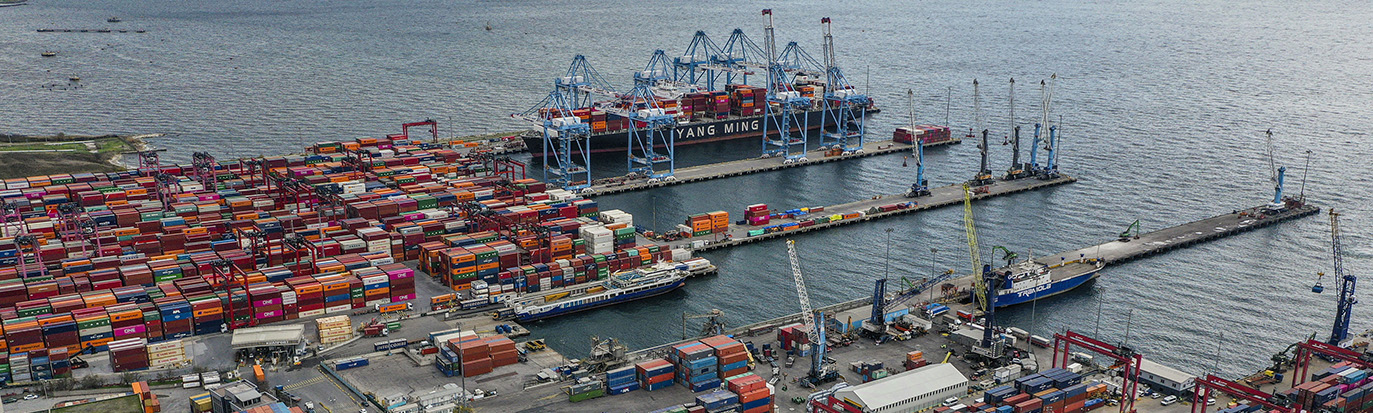
In a global system where nearly 90 percent of world trade is conducted by sea, Türkiye’s strategic importance in maritime transportation continues to grow. Thanks to its unique geography connecting the Mediterranean, Aegean and Black Seas, Türkiye remains at the crossroads of major global shipping routes. According to data from the Ministry of Transport and Infrastructure, the number of ports in Türkiye has increased from 37 to 84, while the capacity of existing ports has been significantly expanded. The tangible impact of these investments is evident in container shipping performance. Based on 2024 Lloyd’s List data, five Turkish ports ranked among the world’s 100 busiest container ports: Istanbul Ambarlı (72), İzmit Gulf-Kocaeli (86), Tekirdağ Asyaport (94), Mersin (98) and, for the first time, İzmir-Aliağa (91).
IRON SILK ROAD
Located at the heart of the Asia-Europe railway network known as the Iron Silk Road, Türkiye aims to increase the share of rail transport in intercontinental freight movement. The Baku-Tbilisi-Kars (BTK) Railway Line is a cornerstone of this strategy. Launched in 2017, the BTK line enables uninterrupted rail connectivity from London to Beijing, placing Türkiye at the core of the Middle Corridor. With this route, freight transit times are reduced from 40–60 days by sea to just 12–14 days by rail, offering a significant advantage in speed and cost. In November 2019, a freight train departing from Xi’an, China, traveled more than 11,000 kilometers in 12 days and reached Europe via the Marmaray Tunnel. This historic journey marked the first Asia–Europe freight train transit through Marmaray. Known as the China Railway Express, the train demonstrated the functionality of the Middle Corridor and showcased Türkiye’s railway transit potential to the world.
Commercial transportation from all directions
Mustafa Ilıcalı, faculty member at Istanbul Commerce University, stated that the steps taken in recent years in Türkiye’s transport and logistics infrastructure have turned the country into one of the essential hubs of global trade. Ilıcalı said: “Türkiye is among the few countries capable of integrating air, land, sea and rail transportation. This integrated structure not only increases freight capacity but also enhances the reliability and speed of supply chains.” Highlighting the Middle Corridor and Iron Silk Road projects, he added: “Risks along the northern route and growing uncertainties in global trade have made alternative routes passing through Türkiye more prominent. The Baku–Tbilisi–Kars railway, the Marmaray connection and port–rail integration have transformed Türkiye into a natural trade hub between Asia and Europe.”